Digital twins transforming biodiversity science
Biodiversity is the foundation of life on Earth. To protect it, we need innovative tools that guide science-based decisions. The BioDT project, coordinated by CSC, brought digital twins to biodiversity science, helping Europe respond faster to global biodiversity and climate challenges.
Biodiversity supports food security, medicine, cultural values, and ecosystem resilience in the face of global change. Yet biodiversity is under increasing pressure from climate change, land-use shifts, and other human impact. To protect it, we need better data, advanced modelling, and innovative tools that can guide science-based decisions.
Traditionally, biodiversity research has relied on relatively modest computing resources. But as data volumes grow and the need for predictive modelling intensifies, demand for high-performance computing (HPC) and sophisticated simulation methods increases in the field. This also creates a higher need for harmonised, open, and quality-controlled data, which is essential for monitoring ecosystem health and informing policy.
Digital twins help understand how ecosystems respond to environmental pressures
Digital twin (DT) projects at CSC push the limits of Earth, climate and biodiversity sciences to provide new tools for research and decision-making by developing digital twins that mimic and predict different aspects of biodiversity dynamics, climatic conditions and extreme events.
Funded under the Horizon Europe Research and Innovation Actions framework, the BioDT project brought the concept of digital twins to biodiversity research. Over the course of three years, CSC coordinated BioDT in a truly collaborative effort that counted on 21 other committed partners all over Europe.
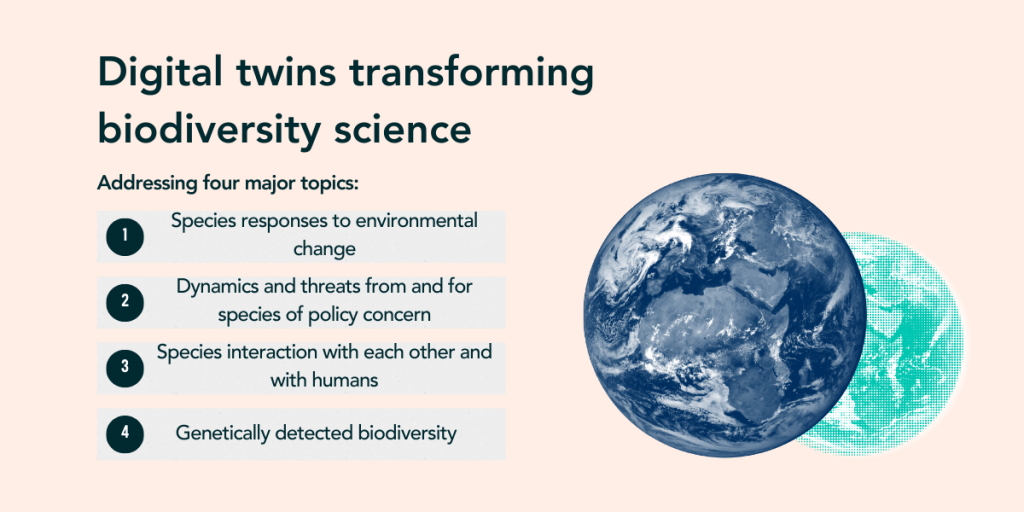
BioDT developed nine prototype DTs (pDTs) addressing four major biodiversity topics:
- Species responses to environmental change
- Dynamics and threats from and for species of policy concern
- Species interaction with each other and with humans
- Genetically detected biodiversity
The pDTs allow users to e.g. simulate forest and grassland productivity under climate and management scenarios, understand bee population dynamics and estimate honey production, map the cultural and biodiversity value of a national park, and map populations of climate-resilient wild crop relatives.
These prototypes leverage EuroHPC supercomputers like LUMI and Karolina, as well as national computing resources, to run detailed simulations that were previously impossible.
Citizen science meets AI
One highlight of BioDT is its integration of citizen science and artificial intelligence. A national-scale bird monitoring campaign in Finland collected over 14.5 million bird song records, with species identified using AI models.
This data from the hugely popular Spring of Migratory Birds (Muuttolintujen kevät in Finnish) mobile app streams into DTs daily, enabling near real-time visualization of bird observations and distribution, while engaging the public in biodiversity science.
Collaboration is key: integrating leading research infrastructures
BioDT’s success is rooted in strong partnerships with major European research infrastructures such as GBIF, LifeWatch, and eLTER. These collaborations ensure seamless data integration and adherence to FAIR principles, creating a robust foundation for biodiversity modelling.
CSC’s role in this initiative is pivotal: by providing HPC resources, data services, and platform engineering, CSC helps bridge the gap between cutting-edge technology and scientific needs, strengthening Finland’s visibility in the European research landscape.
BioDT reinforces CSC’s position as a leader in digital twins, HPC, and data-intensive science.
“Looking ahead, BioDT creates strategic opportunities for scaling digital twin development to other biodiversity topics, for strengthening Finland’s research visibility and infrastructure across Europe and the world, and to support global biodiversity and climate strategies,” says Damien Lecarpentier, Director of International Collaboration & Partnerships at CSC.
“BioDT has demonstrated that digital twins can transform biodiversity science. By combining advanced modelling, open data, and HPC, we can better predict and respond to biodiversity challenges. These innovations support European strategies for biodiversity and climate, promote open science, and pave the way for new tools that benefit research, policy, and society,” says Gabriela Zuquim, Scientific Coordinator at CSC.
Illustrations: CSC
What is a digital twin?
A digital twin is a virtual, interactive replica of a real-world entity or process. It combines data, models, and connectivity to simulate and predict complex dynamics.
In biodiversity science, digital twins can help us understand how ecosystems respond to environmental pressures, enabling better conservation strategies and policy-making.
Read more
More information

Gabriela Zuquim
PhD, Docent Gabriela Zuquim coordinates RDI projects in the fields of digital twins and biodiversity.