
Finnish universities join forces to harness AI in research, education, and innovation
Finland has an excellent opportunity to become a global leader and a European frontrunner in AI adoption. The Finnish universities’ joint AI initiatives will be defined during spring 2026.
How will AI transform research, education, and innovation? Finnish universities are collaborating closely to answer this question – and to ensure that AI is leveraged smartly in their core missions. The shift is so significant that creating a shared understanding requires joint effort.
“Through collaboration, we can identify best practices and consider whether there are areas where joint investments make sense,” says Ilkka Niemelä, Chair of the Board of the Council of Rectors of Finnish Universities (Unifi), and President of Aalto University.
It makes sense to seize the opportunities AI offers for one simple reason: this ensures that Finland can continue to produce world-class research and deliver high-quality education across disciplines.
An active approach by universities benefits society as a whole. In addition to top-level research, Finland holds other strong cards to become a global leader and a European frontrunner in AI adoption: the country recently launched the ELLIS Institute, a joint initiative by universities to advance AI research. Finland also has powerful high-performance computing tools like the LUMI supercomputer, and strong digital capabilities.
When AI is widely integrated into university research and education development, it will also be refined to support businesses and the public sector. This will help Finland ride the crest of the AI wave.
“Changes in companies, other organizations, and more broadly across society won’t happen without educated people who can drive change forward,” Niemelä emphasizes.

Support for university personnel and students through AI transition
Throughout 2025, Finland’s university rectors and vice rectors have built a shared understanding of AI’s opportunities and risks. Discussions have taken place in a workshop series organized by Unifi and CSC, where researchers and experts have shed light on the transformation from multiple perspectives.
The outcome is a set of concise conclusions on what is essential for research, education, data, and infrastructures such as language models. Based on these, universities are outlining joint actions to support AI adoption.
“Managing AI development in universities requires a holistic approach. At times of major change, short-term impacts are often overestimated while long-term effects are underestimated,” Niemelä notes.
He emphasizes that university staff and students will not be left alone in the midst of this transformation. It is the universities’s responsibility to provide them with the right tools and training to ensure that the change happens in a sustainable way.
“We need to consider many aspects related to privacy, ethics, and responsible use of tools,” Niemelä reminds.
How will AI impact research?
AI is transforming research in many ways: researchers can use it to speed up and even automate routine tasks, for example. Entirely new possibilities will also emerge.
Depending on the discipline, it is possible to create better models for climate prediction, streamline costly chemical lab measurements, or help humanities scholars analyze large text corpora. Researchers should approach AI with curiosity and openness.
“It’s fascinating to think about what new things AI tools could enable in one’s own research,” says Arto Klami, Professor of Computer Science at University of Helsinki, who discussed the topic with university rectors in the workshop series.
AI may even give rise to completely new research fields. Still, it will not replace researchers. Their role as drivers of the research process and goal-setters remains essential, Klami says.
What about biases in AI methods or the fact that we don’t fully understand how they work yet? According to Klami, new tools shouldn’t be ignored just because they have weaknesses. It’s important to recognize these issues and look for solutions – for example, by ensuring we have sufficiently diverse data to train AI.
Klami is confident that the scientific community is well equipped for the ethical use of AI.
“Researchers are educated to consider these kinds of questions in other contexts as well.”
Updates to education and teaching
AI will also have a major impact on university education. AI won’t change the cognitive process of learning, but it will change learning methods and content – what teaching should focus on. Both students and teachers can use AI: students as a learning aid, and teachers for assessment and teaching.
“Pedagogical expertise is essential for adopting AI responsibly and guiding students to use it in the right ways. Fortunately, Finnish universities have a strong foundation for this,” says Marja Sutela, Chair of Unifi’s Network of Vice-Rectors for Education, and Vice President at Tampere University.
In the future, AI literacy will be a natural part of experts’ skill sets across fields. It’s important to remember, however, that AI should act as a helper in learning and work, not as a leader. Critical thinking, for example, cannot be delegated to AI, though it can support that process.
“Universities must take AI requirements into account in all degree programs and teaching in general. A key question is what kinds of skills university studies should develop going forward. Will some current content become unnecessary, and what new content will be needed to replace it,” Sutela reflects.
Unique data: Finland’s competitive edge
The AI shift will increase data volumes and diversify its use. Competitive advantages arise where data is unique. Finland has, for example, rich health registry data and other valuable research datasets that can be used to train AI models. This is a major asset.
“Data from research and education should be refined so it can be utilized and combined in many ways in the future,” Niemelä points out.
AI enables data to be processed in new ways, its reliability can be assessed more accurately, and data shared more broadly across disciplines. This could open doors to new breakthroughs.
But how do we make data accessible to researchers? It requires close collaboration with businesses and society at large. In addition, we need an architecture that spans all fields of science to support data management. Critical to leveraging data are infrastructures such as large global language models. They are essential for both researchers and industry. The key question is how to use them wisely and cost-effectively.
It’s important to recognize that closed, opaque language models limit scientific openness and freedom. Finland and Europe must not become overly dependent on solutions offered by big tech companies. Instead, we need to develop our own models and foster AI tools for different disciplines. In research, AI is used in a much broader way than in popular applications like ChatGPT or Copilot.
“Science cannot rely solely on off-the-shelf solutions. A reasoning language model is not enough – on many fields, AI must be grounded in observations and measurements,” Klami says.
Toward solutions for humanity’s biggest challenges
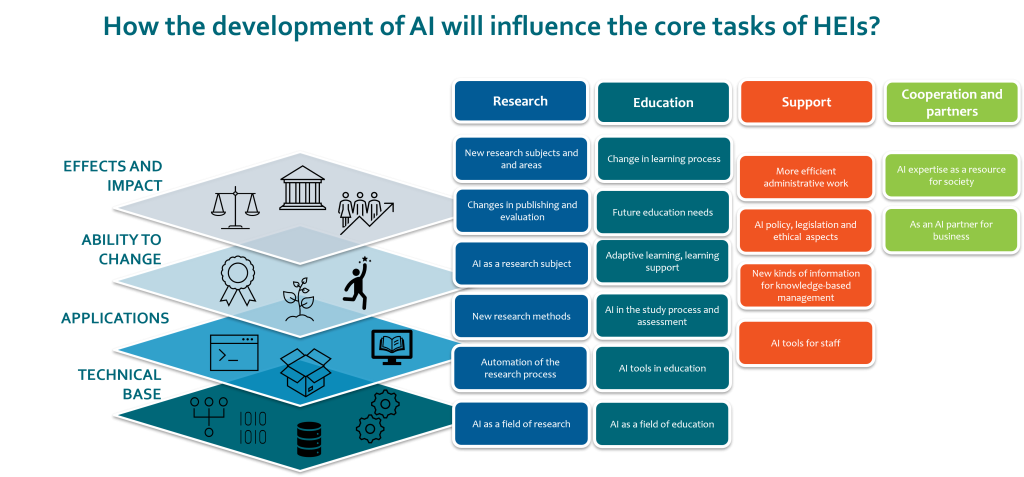
Finnish universities will continue shaping joint AI actions in spring 2026. The work is supported by AITO framework, developed by CSC, that was also used in university rectors’ workshop series. It helps structure how AI affects universities’ missions and from which perspectives to approach the topic.
“Are we talking about urgent AI tool acquisitions or long-term transformation in research and edutation?” describes Hanna-Mari Puuska, Director of Digital Service Ecosystems at CSC.
What is essential is that universities explore AI with curiosity and share best practices. It’s also wise to focus on research that studies the societal and human transformation driven by AI.
“The better we understand AI, the better we can anticipate what’s coming,” Puuska says.
By embracing AI’s potential, universities help humanity tackle its greatest challenges – whether preserving a livable planet or treating diseases. Professor Arto Klami reminds that science remains the best way to find answers.
“When we harness AI to support research processes effectively, it will accelerate solving the most important questions we face.”
Header image: CSC
Read more

Hanna-Mari Puuska
Hanna-Mari Puuska is responsible for developing CSC’s research information and data management services.