
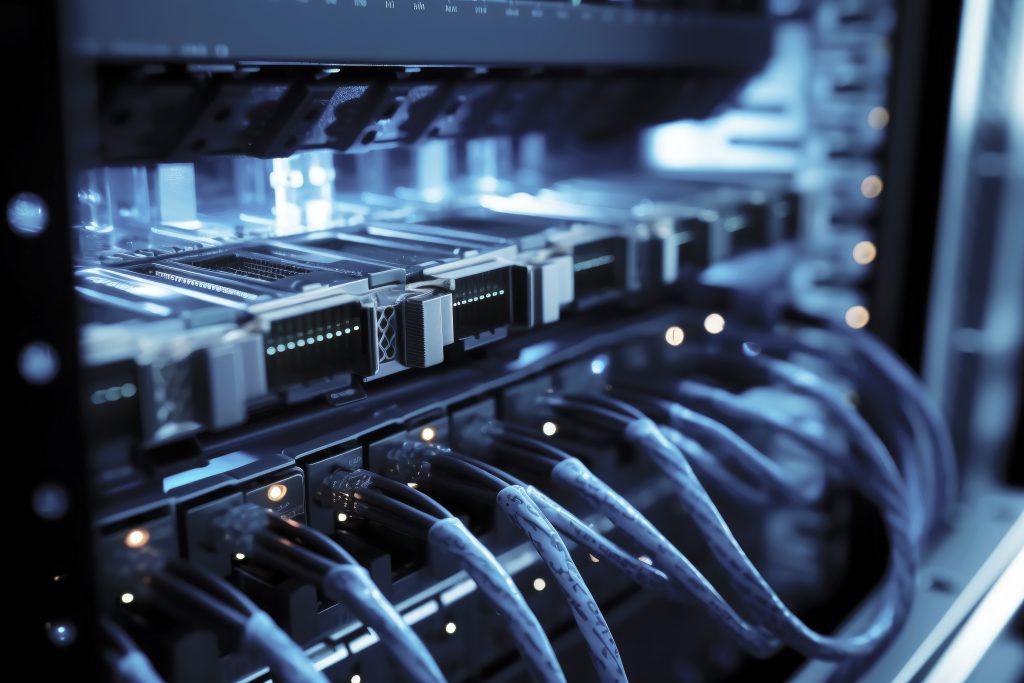
National supercomputer Roihu
Roihu is built for the needs of researchers at Finnish higher education institutions and research institutes. Roihu will provide Finnish researchers with an efficient and versatile computing environment and ensure the competitiveness of Finnish research.
Scientific high-performance computing
A supercomputer is an important research tool in modern science and the use of supercomputers, or high-performance computing (HPC), is becoming more widespread in all fields of science. Having our own national supercomputer ensures that all researchers have access to competitive HPC resources and significantly speeds up research. Supercomputers are also used in university teaching.
Roihu will replace CSC’s current national supercomputers Mahti and Puhti. Roihu will triple the current performance of Finland’s national supercomputing resources.
Roihu’s pilot testing will begin in March 2026, and it will be generally available in April 2026. The call for Roihu pilot projects ended in November 2025.

Roihu is a highly versatile platform for researchers across various fields:
- Most researchers using CSC’s AI-related services train small to medium-sized models, for which Roihu is well suited.
- We are developing the capability in Roihu to process sensitive or confidential data.
- Researchers can use it for example to analyze audio and video materials, compute molecular dynamics simulations, screen potential drug compounds from extensive libraries, simulate glaciers and calculate climate scenarios.
- The educational use of HPC in higher education institutions is a new and growing field. While it doesn’t demand extensive computing resources, it involves a large number of users. This approach helps cultivate the next generation of researchers across all disciplines and prepares skilled experts for industry.
What is a supercomputer?
A supercomputer is one of the world’s fastest-performing computers. One of the criteria is making it to the list of the world’s top 500 supercomputers. The computing power of supercomputers is expressed as flops, or calculations per second. This abbreviation stands for floating point operations per second. A floating point number is the number format used in computing.
The performance of a supercomputer depends largely on its high-speed interconnect network and memory capacity rather than exclusively on its power and number of processors. Two types of processors are used in supercomputers: CPUs and GPUs. Of these, central processing units (CPU) are conventional general-purpose processors.
A newer and increasingly popular GPU (graphics processing unit) was originally developed as a graphics processor. Today, GPUs are widely used in supercomputers, particularly for processing large datasets and artificial intelligence. Software in other scientific fields has also advanced significantly in recent years, allowing GPUs to be utilized more broadly than ever before.
The latest development focus is on combining high-performance computing, quantum computing and artificial intelligence.
The life cycle of a supercomputer is approximately six years.
Read more
More about Roihu
Roihu is built on BullSequana XH3000 hybrid system by Eviden. Roihu will have:
- 486 CPU nodes, 132 GPU nodes and special purpose nodes for visualization and high memory tasks.
- Each CPU node will have two 192-core AMD Turin 9965 CPUs while the GPU nodes will be equipped with four Nvidia GH200 Grace Hopper superchips. Each GH200 superchip comprises one Hopper GPU and one Grace CPU with 72 ARM CPU cores.
- Two independent flash-based parallel file systems – a 6.0 PiB scratch space and a 0.5 PiB storage system for project applications and users’ home directories. The scratch disk performance will be tenfold compared to Puhti.
The high-performance LINPACK (HPL) performance is estimated to to exceed 10 Pflops for the CPU nodes and 20 Pflops for the GPU nodes.
- About Roihu in detail (docs.csc.fi)
- How to start using CSC’s services

Sebastian von Alfthan
Sebastian von Alfthan is responsible for CSC’s national supercomputing services and develops the high-performance computing ecosystem.

Eeva Nyrövaara
Eeva Nyrövaara is a Customer Solution Manager for scientific computing.
Subscribe to our newsletters!
From our newsletters you will get up-to-date information about the services we offer for research and the trainings we provide.