

Help is closer than you think: Support and solutions for your HPC journey
In our annual Data Management and Computing Services’ user survey we received a lot of thoughtful and constructive feedback on our support services and we truly appreciate it.
It’s especially rewarding to hear positive comments, as supporting you is something we invest a great deal of time and care in. In this blog post, we would like to address some of the direct feedback we have received from the survey.
Help is always available – you’re not alone
Customer support has been excellent.
One thing we noticed in the feedback is that many questions and requests already have solutions available. The challenge is often simply that these solutions are not widely known or easy to find. That’s something we want to improve.
Reaching out to our Service Desk (servicedesk (at) csc.fi) is always the right move, even if your question feels simple. What might seem like a quick answer can sometimes require input from several specialists behind the scenes. These cases often evolve through a bit of back-and-forth, and fortunately our ticketing system makes that collaboration smooth and efficient. While not every issue is unique, you might be surprised how many really are.
That said, not everything is best solved over email.
Sometimes it’s easier to just talk
Customer support is friendly and helpful—thank you for that.
Explaining a problem in writing can be tricky. Often, the fastest way forward is to simply show what’s happening and discuss it together. Many of our users have expressed a wish for more direct and approachable way to interact with us.
That’s exactly why we run our weekly user support sessions every Wednesday from 14:00 to 15:00 (Finnish time). These sessions are designed to give you a space where you can share your screen, ask questions, and get real-time help from our specialists.
We’re glad to see these sessions have been well received. In addition to support, we often include short talks on current topics, and we now always offer a dedicated “beginners’ room” to keep the threshold for asking questions low.
We recommend checking out our colleague’s short and entertaining talk on how to write a good support request (recording, materials). It highlights an important point: we can’t read minds or access files we haven’t been shown. The more context you can provide, the faster we can help, especially when multiple CSC experts are involved.
CSC and the Ambassadors are close to you
Providing IT personnel with additional knowledge and expertise would enable them to better guide the selection of the appropriate solution.
CSC does not involve its customers in the development of its services.
Our services are shaped through close collaboration with the research community. CSC receives regular feedback via CSC’s Scientific Customer Panel, which provides valuable insights into user needs and priorities.
In addition, our ambassador network plays an important role: ambassadors are invited to share feedback and engage in direct discussions with our service developers during our annual in-person meeting and topical online meetings. Ambassadors are researchers, research software engineers, IT specialists, and support staff. They may act as local points of contact on your campus, help colleagues choose suitable tools and services, share news and training opportunities, and can guide researchers toward the right place for deeper support when needed.
The learning curve of HPC – and how we help
It has a steep learning curve.
The services are not easy to use, particularly for those who are just beginning their studies or work.
More training should also be offered outside Espoo./ Training could be extended to the provinces.
Another recurring theme in your feedback is the steep learning curve of high-performance computing (HPC). And you’re absolutely right: getting started isn’t always easy.
Using HPC effectively requires understanding how supercomputers work, learning some command line basics, and combining that with your own scientific expertise and domain-specific tools. It’s a lot to take in, but you don’t have to figure it out alone.
We offer a self-learning course that guides you step by step, from getting your account to running your first jobs and eventually using resources efficiently. We also run instructor-led online versions of our “CSC Computing Environment” courses twice a year, where you can ask questions and get hands-on support from our team.
We are working closely with universities and higher education institutions to integrate this training into local teaching. For example, we have courses in Kumpula, Aalto, and Jyväskylä (in August 2026). If you think your campus would benefit from a local course, guest lecture or satellite session, be in touch!
And to make things easier, many tools are now available through web interfaces, so not everything requires a command line anymore.
We are currently piloting a machine-translated Finnish version of our user guides at docs.csc.fi. The original English documentation remains the primary source, and updates are automatically translated into Finnish to keep both versions aligned. This is something many of you have requested in your feedback, and we hope it will make our documentation more accessible. Providing a fully maintained Finnish manual has been challenging, as many of our specialists – as well as our customers – work primarily in English.
Why doesn’t a supercomputer work like my laptop?
On some days, I have to wait for hours for the program to run.
If only I could receive an endless number of BUs.
I would remove the billing unit system.
This is a question we hear often, and it’s a fair one.
Supercomputers are shared environments, used by thousands of researchers. Instead of being dedicated to a single user, resources are allocated through a scheduler that essentially plays “Tetris” with incoming jobs to ensure fair sharing and efficient use of resources. This means there can be queue times — but it also means the system is used responsibly and sustainably, without wasting energy on idle machines. At CSC, this shared approach allows all our users equal access to powerful computing resources.
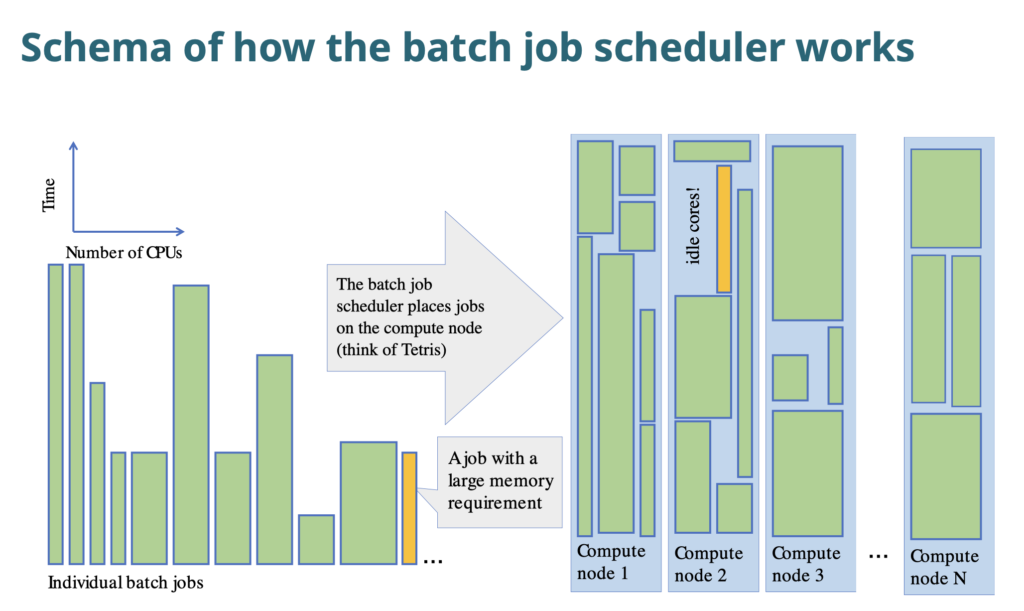
Researchers must apply for Billing Units because CSCs resources are a shared, publicly funded commodity that needs careful planning, accounting, and fairness guarantees. The BU system gives both the researchers and CSC a common, transparent language for resource consumption. Without some kind of application system, the supercomputers and cloud would quickly become over‑booked.
Applying for Billing Units is designed to be quick and straightforward — typically it only takes a couple of minutes to get started. CSC aims to be among the most agile HPC providers in Europe.
Software, modules, and your own environment
This software is important for our research.
Unlike your personal computer, a supercomputer must support a wide range of users and software — often with conflicting requirements. That’s why we use modules, which allow users to work in their own isolated environments without interfering with others (read more on the module system on docs.csc.fi).
With modules and containerised Conda environments, most common software packages are easy to access. Before installing anything yourself, it’s always worth checking what’s already available. You might save yourself a lot of effort.
If the software you need isn’t installed, you have options:
- You can install it yourself in your own environment.
- You can request it. We maintain a wishlist and regularly review user needs.
We’re here to help
Whether you’re just getting started or already an experienced user, support is always available. If you’re unsure about something, chances are there’s already a solution. If not, we can help you find one.
So don’t hesitate to reach out, join a support session, or explore the available resources. We’re here to make your HPC journey smoother, more efficient, and hopefully even enjoyable.
Hero image: Adobe Stock.
Authors:
Maria Lehtivaara, Application Specialist, CSC
email: maria.lehtivaara (at) csc.fi
Yann Pfau-Kempf, Application Specialist, CSC
email: yann.pfau-kempf (at) csc.fi