
LUMI-Q consortium unveils the VLQ quantum computer for the European science community
A new quantum computer named VLQ was officially inaugurated today at IT4Innovations National Supercomputing Center in the Czech Republic, in the presence of prominent Czech and European representatives. VLQ is the second quantum computer launched in Europe under the EuroHPC Joint Undertaking. This important milestone marks another step towards building a cutting-edge European quantum computing infrastructure and supporting research and innovation across the continent. The acquisition and operation of VLQ is jointly managed by the pan-European LUMI-Q consortium, which brings together thirteen partners from eight countries.
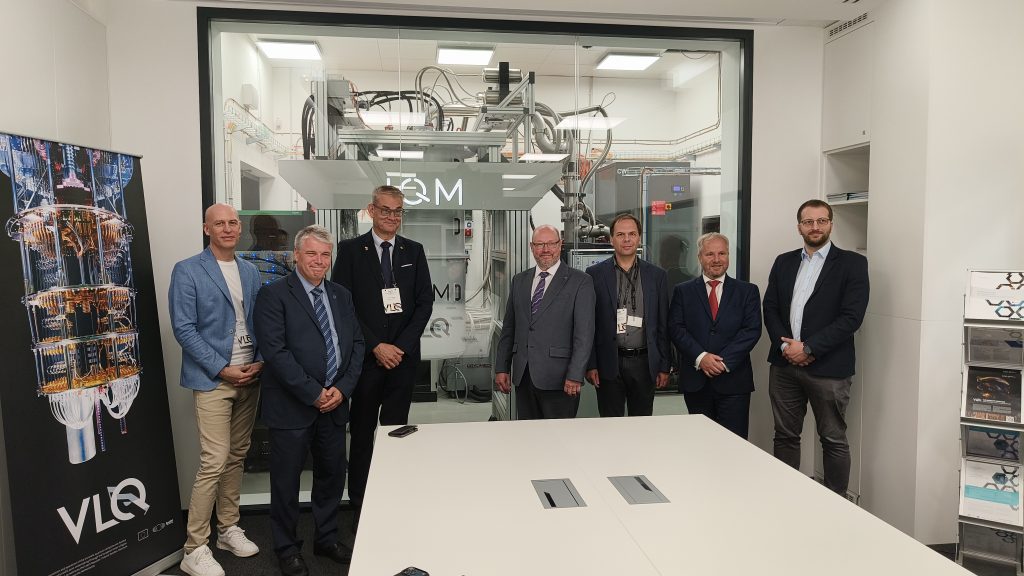
The inauguration ceremony took place at IT4Innovations National Supercomputing Center, part of VSB – Technical University of Ostrava. It was attended by many distinguished guests, including Gustav Kalbe from the European Commission’s Directorate-General for Communications Networks, Content and Technology, Anders Dam Jensen, Executive Director of EuroHPC JU, Czech government officials, rectors of Czech universities, and representatives of the LUMI-Q consortium.
VLQ is a quantum computer with 24 physical qubits in a star-shaped topology. This architecture provides unique connections between qubits, significantly increasing the efficiency of quantum computations and distinguishing VLQ from competing systems. The topology offers a computational advantage by minimising the number of so-called swap operations. The system was supplied by Finnish IQM Quantum Computers at a total acquisition cost of approximately EUR 5 million. Half of the cost was funded by EuroHPC JU, with the other half covered by the LUMI-Q consortium. The consortium comprises thirteen partners from eight European countries. It is led by the Czech Republic and includes Belgium, Denmark, Finland, the Netherlands, Norway, Poland, and Sweden.
“The VLQ quantum computer will serve a broad spectrum of European users – from academic institutions and industrial companies to the public sector. It will primarily support research and innovation, and its capacities will be accessible to all users across Europe via the EuroHPC JU,” said Branislav Jansik, Director of Supercomputing Services at IT4Innovations and coordinator of LUMI-Q consortium.
VLQ quantum computer opens up the possibility for hybrid computing on the EuroHPC supercomputing platforms
VLQ will enable researchers to explore new algorithms and applications in areas such as quantum machine learning, drug and vaccine development, new material design, transport optimisation, the financial sector, the performance forecasting of renewable energy resources, and security and defence.
The quantum computer will not function as a standalone computational system. Like other EuroHPC JU quantum computers, it will be integrated into the European high-performance computing (HPC) infrastructure. VLQ is directly connected to the Karolina supercomputer, enabling combined classical and quantum computations. Later this year, VLQ will also be connected to the LUMI supercomputer.
“With VLQ, Europe is taking another decisive step towards building a cutting-edge quantum computing ecosystem. By combining the power of our supercomputers with state-of-the-art quantum technologies, we are providing European users with tools to find solutions once thought impossible. Today’s inauguration also demonstrates the strength of European collaboration: together, we are laying the foundations for groundbreaking discoveries that will shape the future of science, technology, and society,” said Anders Dam Jensen, Executive Director of the EuroHPC JU.
“We congratulate IT4Innovations, the members of the LUMI-Q consortium and the EuroHPC JU on this landmark day, when the VLQ quantum computer opens up the possibility for hybrid computing on the EuroHPC supercomputing platforms, ensuring European users in academia and industry access to the emerging field of quantum-accelerated HPC,” said CSC’s Managing Director Kimmo Koski. CSC operates the EuroHPC LUMI supercomputer in Kajaani, Finland, in collaboration with the LUMI consortium.
“It will be exciting to follow how our end-users across Europe will make use of the quantum computer. The innovative layout of the quantum processing unit, QPU, allows for intriguing explorations in high-impact fields such as quantum AI, error correction, and for exploring fundamental physics phenomena,” mused Mikael Johansson, Deputy Director of LUMI-Q and Manager for Quantum Technologies at CSC.
More interesting facts about the VLQ quantum computer
- The VLQ quantum computer contains 24 superconducting qubits in a star-shaped topology.
- By the end of 2025, VLQ will be accessible to researchers, companies, and the public sector across Europe.
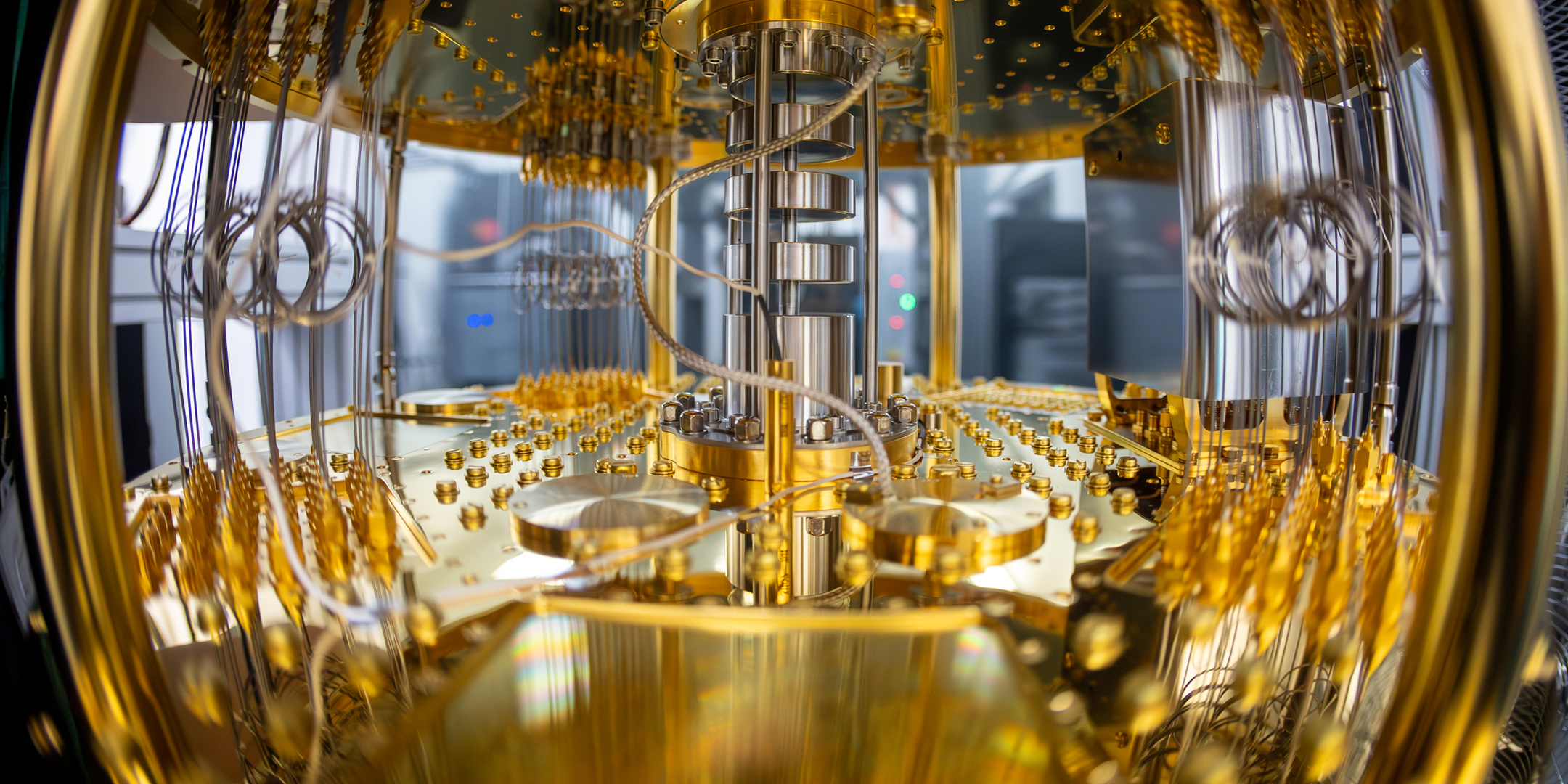
- To operate, its qubits must be kept at an extremely low temperature — just 0.01 Kelvin above absolute zero (i.e., about –273.14 °C), colder than outer space. This “frozen” state is provided by a special cryostat, part of which resembles a multi-tiered, gleaming gold chandelier weighing approximately 300 kg. Such cooling is essential, as even a tiny amount of heat could destroy the fragile quantum states of the qubits. The chip itself is located at the bottom of the cryostat, and achieving these ultra-low operating temperatures relies on quantum effects when mixing helium isotopes.
- Despite the demanding cooling, the quantum chip consumes only a few kilowatts of energy. The supporting infrastructure and cooling systems use most of the power, which is still far less than classical supercomputers, which require megawatts.
- The name VLQ refers to:
- V – VSB – Technical University of Ostrava (where it is located)
- L – LUMI-Q Consortium
- Q – Quantum Computing
- However, when pronounced, the name sounds like the Czech word “vlk,” which means wolf, the symbol of the LUMI supercomputer from which the LUMI-Q consortium originated.
Image on top: copyright IT4Innovations
Read more
Media enquiries
Zuzana Cervenkova, Spokesperson for IT4Innovations National Supercomputing Center
zuzana.cervenkova@vsb.cz
Phone: +420 602 593 335
media@lumi-supercomputer.eu

Mikael Johansson
Mikael Johansson enables the uptake of quantum computing and communications at CSC, and develops quantum infrastructure as an integral part of the high-performance computing ecosystem.