Pilot users selected for the Roihu supercomputer
The first users for Roihu, CSC’s next-generation supercomputer, have now been selected. These pilot projects will run as a part of Roihu’s acceptance phase, providing essential real world workloads to validate the system.
A substantial number of high‑quality proposals were submitted by universities, research institutes and companies alike. CSC’s resource allocation group evaluated all 49 applications and selected 28 projects whose computational profiles are best suited to testing the full breadth of the new system.
Together, these projects will ensure that Roihu’s capabilities are exercised comprehensively under demanding, scientifically meaningful conditions. The projects not chosen are moved to a waiting list, from which they can be promoted to pilot projects if any of Roihu’s computing capacity remains unused.
Many of the selected pilot projects utilize artificial intelligence. These include projects developing new language models (Cheng, Ginter, Tiedemann), identifying new areas with mineral potential from complex geophysical datasets (Nidhi), and advancing faster, more efficient and more accurate weather‑forecasting methods (Bouvier).
Tigany Zarrouk investigates solid electrolyte interphase in Li/Na-ion batteries, in which solid electrolyte could significantly improve battery longevity and safety.
Ina Pöhner examines whether experimental data could be used to refine a new AI model—and whether such a model might replace current virtual‑screening approaches in the search for drug candidates.
The chosen pilot projects:
- Lu Cheng, University of Eastern Finland: Large language model for scRNA-seq data
- Jun Yang, University of Helsinki: Data Management for Efficient Machine Learning Pipelines
- Alexander Mahura, University of Helsinki: Seamless multi-scales and -processes meteorology and atmospheric composition modelling for the Pan-Eurasian EXperiment (PEEX) domain
- Dipak Kumar Nidhi, University of Turku: Machine Learning in Mineral Prospectivity Mapping
- Rostislav Kouznetsov, Finnish Meteorological Institute: SILAM Roihu tests
- Clément Bouvier, University of Helsinki: AI-Dream: Does Artificial Intelligence dream of imaginary clouds? – How to use Artificial Intelligence to build the next generation of forecasting system
- Johannes Niskanen, University of Turku: Spectral Informatics,
- Tero Hiekkalinna, University of Helsinki: Assessing the Predictive Accuracy and Biological Relevance of Polygenic Risk Scores in Diverse Genomic Landscapes
- Esa Rahtu, Tampere University: Generative Foley Diffusion Transformer
- Jenni Hultman, Luke: Soil metagenomic assemblies
- Minna Palmroth, University of Helsinki: Vlasiator Ionosphere and GPU Large-scale Unification
- Tatu Pantsar, University of Eastern Finland: SOLUTION: Investigation of the role of water in drug resistance and inhibitor binding
- Till Sawala, University of Helsinki: Effects of Domain Geometry on the Evolution of Structures
- Declan O’Donnell, Finnish Meteorological Institute: FMI Continuing Contribution to Global Climate Modelling
- Filip Ginter, University of Turku: LLM Enhancement and Restoration of Finnish Historical Text Collections
- Tigany Zarrouk, Aalto University: A Foundational X-ray photoelectron spectroscopy model for the Solid Electrolyte Interphase of Li-ion battery anodes
- Maarit Korpi‑Lagg, Aalto University: Dynamos in strongly stratified and rotating convection in spherical shells
- David Weir, University of Helsinki: GRAvitational wave Production in the early universE 2.0
- Alex Bunker, University of Helsinki: Rational Design for drug delivery nanoparticles
- Mikko Karttunen, University of Eastern Finland: Energetics of Lipid And Sterol Temporal Interactions in Cells
- Kuanzg Zhang, University of Helsinki: Evolving HILA: Enabling GH200 Acceleration for the Framework and Its Applications
- Sampo Pyysalo, University of Turku: CommonSynt North: Permissive data and models for Nordic languages
- Karoliina Honkala, University of Jyväskylä: Targeted machine learning interatomic potentials for CO2 and biomass conversion
- Jörg Tiedemann, University of Helsinki: Efficient Multilingual NLP
- Mikko Kurimo, Aalto University: Parakeet Finnish ASR baseline
- Ina Pöhner, University of Eastern Finland: Are We There Yet? Testing Co‑Folding as a Docking Stand‑In for ABL1 Secondary Pockets
- Mariella Särestöniemi, Oulu University: MicroWave and mmWave sensing in medical monitoring applications
- Luigi Acerbi, University of Helsinki: Foundation Learning for Amortized Measurement and Experimentation
The pilot phase for Roihu will begin in April. If the four‑week testing period proceeds without major issues, Roihu will be opened for general use in June.
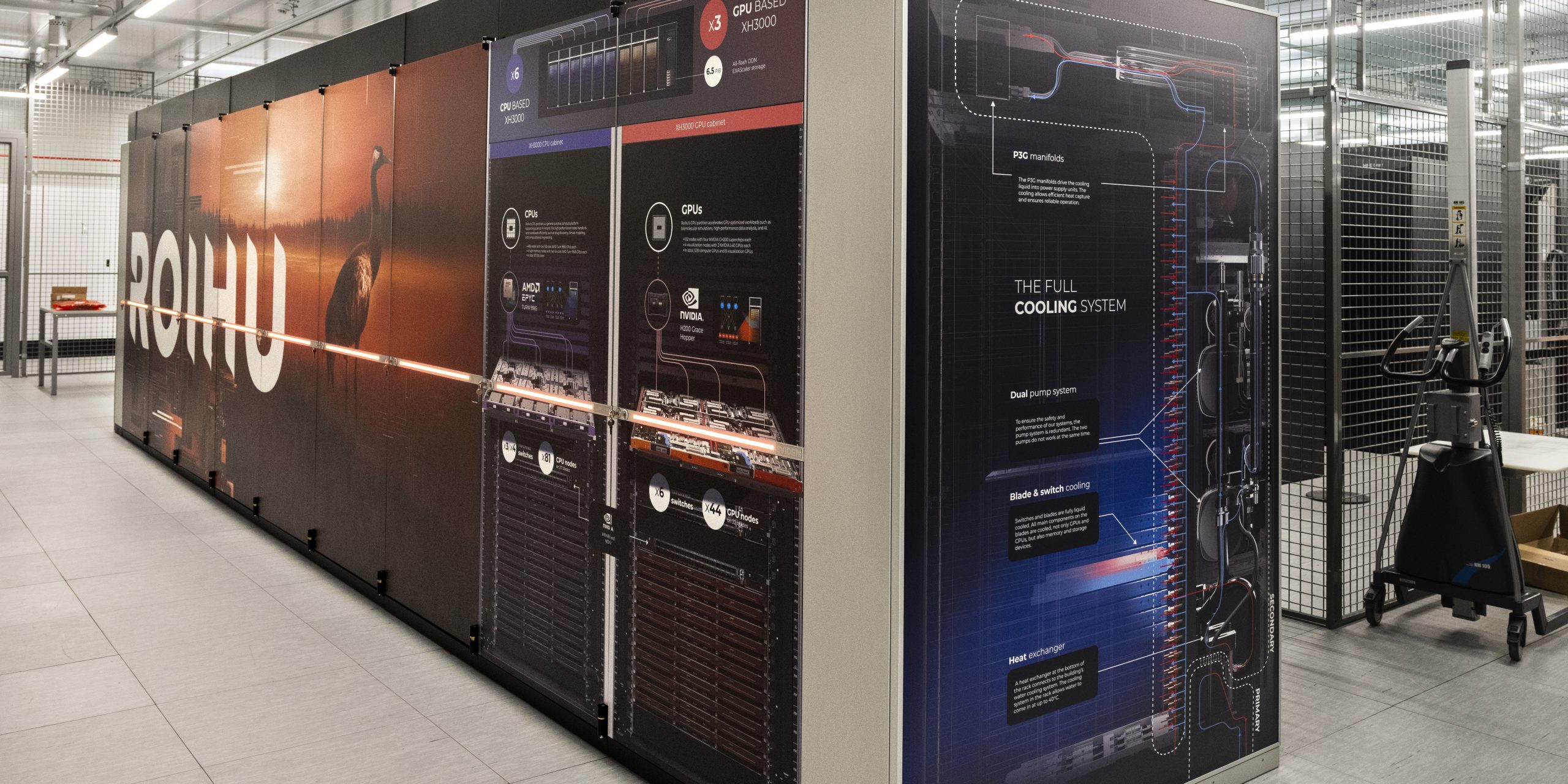
Roihu is Finland’s next national supercomputing system, set to replace the current Mahti and Puhti supercomputers. Roihu is built on BullSequana XH3000 hybrid system by Eviden.
(Edited 29.4.2026: GA changed from May to June. 12.3.2026: The start of the pilot projects changed from March to April and GA from April to May.)
Photo: CSC. Photographer: Pekka Agarth.